
There is an excellent rationale for cross-functional teams. For large programs, that rationale can be easily scaled to the program-level. But, for some reason, this isn’t always recognized.
TEAM CROSS-FUNCTIONALITY
Let’s say you have a team with the following profile of highly siloed individuals:

This is great if you have a profile of stories that fits it perfectly, as follows:

But what if your set of sprint stories looks more like this?:
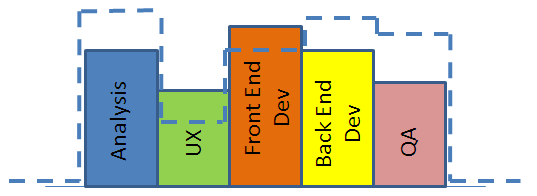
In this case, you have a deficiency of analysts, back-end developers, and QA people to implement the stories that your aggregate team capacity might otherwise support. And, your UX folks and front-end developers will be twiddling their thumbs for part of the sprint.
So, what to do?
Since you are only as good as your lowest capacity component (which appears to be QA, from this particular example), you will have to scale back the number of stories to fit the profile, as shown:

Now, everyone is underutilized, except for QA. Good luck finding something useful for everyone else to do in the next two weeks.
The net result is that your team is perhaps 30% less productive than it could be (eyeballing the graphic).
However, if you take advantage of standard cross-functional teamwork, your team’s profile may look something like this:

Note that by “cross-functional” we do not mean that everyone should be able to do anything. There are very valid reasons (education, experience, proclivity, enthusiasm) why certain people are ideally suited for certain kinds of work. Think of the cross-functional nature of someone’s role on a team as a bell curve (alternatively, some talk about T-shaped employees – the T is just the bell curve upside down, as the Y-axis orientation is arbitrary). The more the curve is spread out, the more they are able to take on other people’s roles. On a good cross-functional team, the bell curves overlap “somewhat,” meaning that everyone can take on a little bit of someone else’s role, although perhaps not as efficiently. Still, this allows a team to take on a wide variety of “profiles” of sprint work, as will always be necessary.
So, for example, in the case above,
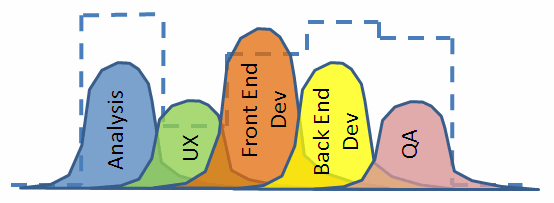
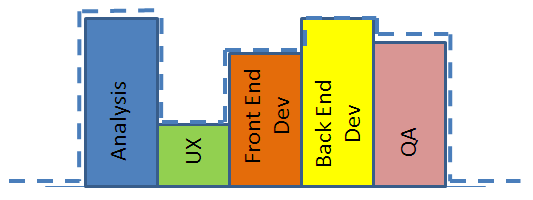
people will adjust to the desired “sprint needs” profile as follows:
PROGRAM LEVEL CROSS-FUNCTIONALITY
Don’t forget that this model can be applied to more than just teams.
For example, there can be a tendency for teams to develop “specific expertise”, due perhaps to knowledge held by certain BSAs or specific architectural or design skills in the development team. The program may then tends to assign stories based on this expertise under the theory that this is the most efficient way to get work done. Unfortunately, this has the effect of only further driving each team into a functional silo. It can become a vicious spiral and soon you may hear things like “well, we don’t have generic teams and, at this point, the schedule is paramount, so we need to keep assigning program work according to the team best suited to do it.” As a result, program backlogs will consist of stories pre-targeted to specific teams, even arbitrarily far out in time. Imagine what happens when the stakeholders decide to re-prioritize epics or add new features, or a new dependency arises that doesn’t line up with the ideal team at the right time. The result will be a work profile that doesn’t match the “team profile,” as follows:

Enter a cadre of fix-it people – project managers, oversight groups, resource managers, program managers – all trying to re-balance the backlog, shuffling stories around, adding people to teams, squeezing some teams to do more work, while other teams tend to be idle, therefore resulting in the assignment of less than necessary filler work. It is the same wasteful resource management nightmare that is so easily solved by cross-functional teams, except this time at the program level.
So, eliminate the waste, and follow the following simple program level guidelines:
- Create a fully prioritized program backlog without consideration for the teams that will be executing the stories.
- Once per sprint, have a program planning session or meta-scrum (Uber-PO, Uber-SM, team representatives) where the candidate stories for the upcoming sprint are identified for each team. Include a little more than each team’s velocity would otherwise indicate in case they are able to take on more than their average.
- Make it a goal to avoid specializing teams.
All team “profiles” will be identical and program needs can easily be accommodated.

There may be a little bit of short term inefficiency resulting from having the “slightly less than ideal” team work on particular stories, but the more you do this, the more that inefficiency evaporates. And the advantages are significant:
- Holistic view of program backlog allow you to focus on what is important – delivering value
- No need to engage the expensive swat team of fix-it managers to shuffle around people and project artifacts
- All team members gain experience and learning, often resulting in greater job satisfaction, and higher performing teams
- No more single point of failure; no more critical path team
- Far less chaos and confusion, resulting in more focused individuals
- Extremely easy to manage – program progress is measured by the simple rate at which all teams work through the stories. Any gaps in targeted scope versus expected scope is easy to identify.

 Agile Accelerate